
















Guide
The principle of the polystyrene foam cutter

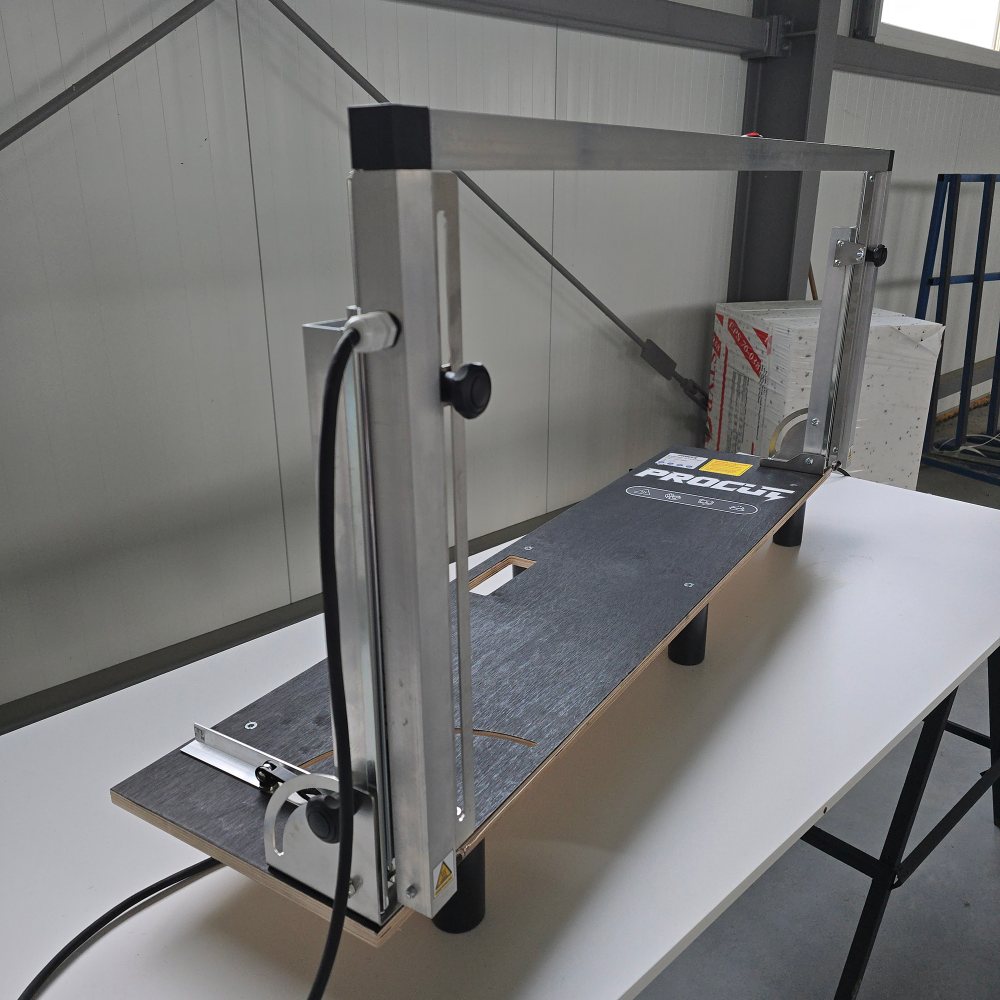
A Styrofoam cutter with a resistance wire operates on the principle of electrical resistance—the NiCr 80-20 wire heats up to a temperature of 250–400°C within 1–2 seconds of turning on the power supply, melting the Styrofoam along the cut line without producing dust, debris, or burrs. It is precisely this precision and cleanliness of the cut that make resistance-wire devices the industry standard in the construction and thermal insulation sectors.
In this article, you will find a complete technical description: how it works, the types and specifications of resistance wires, how to select the wire gauge and power supply rating, the construction of the cutter, and safety guidelines..
How does a Styrofoam cutter with a resistance wire work?
A resistance-wire cutter cuts expanded polystyrene (EPS), extruded polystyrene (XPS), and PIR/PUR foams using the Joule effect—a NiCr 80-20 (80% nickel, 20% chromium) with a resistivity of 1.09 Ω·mm²/m converts electrical energy into heat. When current flows through it, the wire heats up to an operating temperature of 250–400°C in 1–2 seconds, and contact with the material causes it to melt locally and be cut precisely.
Result: a smooth, even edge with no mechanical damage to the polystyrene structure, no EPS dust, and none of the noise typically associated with cutting with a saw or knife.
Operating temperature of NiCr 80-20 wire: 250–400°C | Heating time: 1–2 seconds | Electrical System Performance: 60–70%
Styrofoam cutters The models available in the Pro-Cut line (Minova and Procut brands) are equipped with an electronic power regulator that allows for smooth adjustment of the wire temperature within a range tailored to the thickness and type of material being cut. NiCr 80-20 heating wire The nichrome alloy used in Minova Pro cutters is a professional-grade alloy that ensures a stable temperature even during intensive, prolonged use.
Resistance Wire — Types, Properties, and Comparison of Alloys
The most commonly used heating wires for cutting polystyrene and insulation materials are NiCr 80-20 (nichrome) and Kanthal A1. They differ in maximum temperature, resistivity, and intended use—see the comparison table below:
| Stop | Ingredients | Max. temp. | Resistivity (Ω·mm²/m) | Application |
|---|---|---|---|---|
| NiCr 80-20 (nichrome) | 80% Ni, 20% Cr | 1,200°C | 1,09 | EPS, XPS — Standard Cuts for Building Insulation |
| Kanthal A1 | Fe-Cr-Al | 1,400°C | 1,39 | PIR/PUR, high-density foams, industrial applications |
| Inconel 600 | Ni-Cr-Fe | 1,000°C | 1,03 | Precision EPS, Models, and Prototypes |
We recommend using wire to cut EPS and XPS on the construction site NiCr 80-20 — This is the most readily available and proven alloy, resistant to repeated heating and cooling under everyday operating conditions. Use Kanthal for materials requiring higher cutting temperatures (PIR/PUR, Styrodur with a density above 35 kg/m³).
Characteristics of a good resistance wire for cutting Styrofoam:
- High resistance to repeated heating and cooling (hundreds of cycles without cracking)
- Stable electrical resistance across the entire operating temperature range
- Resistance to corrosion and oxidation at temperatures of 250–400°C
- Available in thicknesses ranging from 0.2 to 0.8 mm, tailored to the power supply's output
- Easy replacement — a wire of the appropriate thickness and length can be cut to size and secured in the terminal
Selecting the Thickness of Resistance Wire — Recommendations Table
The thickness of the wire directly affects the heating rate, the required power supply capacity, and the service life. Thinner wire heats up faster but is more prone to breaking under tension or vibration. Thicker wire requires more power but is more durable under heavy use.
| Wire thickness | Required power supply capacity | Material / Application | Shelf Life |
|---|---|---|---|
| 0.2 mm | 80–130 W | Thin EPS (up to 50 mm), DIY projects, crafts | Low (brittle) |
| 0.3 mm | 130–200 W | Standard EPS/XPS (50–150 mm), workshops | Average |
| 0.5 mm | 200–260 W | Thick EPS/XPS (150–300 mm), Minova Pro, Procut Base | High |
| 0.8 mm | 260–400 W | Industrial, PIR/PUR, very high-density XPS | Very high |
Practical rule: For the Minova Pro 260W and Procut Base 200W cutting machines, use NiCr 80-20 wire with a thickness of 0.5 mm — This is the optimal balance between heating speed, edge quality, and wire life (approximately 50–100 hours of operation under normal use).
Electrical Parameters and Operating Temperature of the Resistance Wire
260W power supply The Minova Pro wire cutter maintains a stable temperature of the NiCr 80-20 wire (ø 0.5 mm, length 130 cm) within the range of 300–350°C during continuous operation. The efficiency of the entire electrical system is 60–70%—this means that the power supply must deliver more power than would be indicated by the wire resistance calculations alone.
| Cutter Model | Power supply power | Wire length | Operating temperature | Materials |
|---|---|---|---|---|
| Procut Base | 200 W | 108 cm | 250–320°C | EPS, XPS up to 200 mm |
| Minova Pro | 260 W | 132 cm | 280–380°C | EPS, XPS up to 300 mm, Styrodur |
| Industrial Models | 400 W+ | 150–200 cm | 350–450°C | PIR/PUR, engineering foams |
Key aspects of working with resistance wire:
- Power adjustment — The electronic controller allows you to adjust the temperature based on the thickness of the material: soft EPS requires a lower temperature than hard XPS
- Temperature Stability — A good temperature controller maintains the temperature with an accuracy of ±10°C, preventing the edges from burning
- Security Measures — The Minova Pro and Procut wire cutters are equipped with thermal protection to prevent the wire and power supply from overheating
- Wire Tension — If the wire is too loose, it bends during operation and results in a crooked cut; the spring tension system compensates for thermal expansion
How do you calculate the required power of a power supply?
Required power supply output: P = U² / R, where R is the resistance of the wire (resistivity × length / cross-sectional area). For a 0.5 mm diameter NiCr 80-20 wire 130 cm long, the resistance is approximately 5.7 Ω. At a voltage of 36 V, the power dissipated in the wire is ~228 W. Due to the efficiency of the 65% circuit, the power supply must have a minimum power rating of 260 W—hence the selection of the Minova Pro power supply.
Construction and Components of a Styrofoam Cutter with a Resistance Wire
Minova Pro 260W cutting machine It consists of 5 main components, the quality and mutual alignment of which directly determine the precision and repeatability of the cut:
| Element | Function | Key feature |
|---|---|---|
| Workbench with slides | Stable base and fabric feed | Steel frame, adjustable cutting angle stops |
| Electronic Power Controller | Wire Temperature Control | Digital display, power range 0–100% |
| Wire Tensioning System | Maintaining the straightness of the cut | Spring-loaded thermal expansion compensator |
| Terminal clamps | Quick Replacement of the Resistance Wire | Tool-free replacement in 2–3 minutes |
| Security Measures | Overheating and Overload Protection | Thermostat, fuse, circuit breaker |
The structural frame of a polystyrene cutter must ensure rigidity when working with long lengths of material—frame deflection causes a crooked cut. The Minova Pro and Procut Base models feature steel profiles that ensure stability when cutting panels up to 300 mm thick.
Workplace Safety — Health and Safety When Cutting Styrofoam with a Resistance Wire
Safety Guidelines for Using a Resistance Wire Cutter:
- Ventilation — Minimum air exchange rate of 10 m³/h per workstation; use an exhaust fan during continuous operation
- Respiratory Protection — an A1P2-rated respirator for strenuous work or when working in an enclosed space
- Hand Protection — heat-resistant gloves when replacing the wire (the wire cools down about 30 seconds after the power supply is turned off)
- Safe distance — Keep at least 20 cm between your hand and the heated wire while cutting
- Substrate — Do not place a hot wire on flammable surfaces (wood, cardboard); use a metal holder or stand
- Power Off — Always turn off the power supply before replacing the wire, making adjustments, or taking breaks
- Never cut PVC — Chlorinated plastics (PVC, polystyrene containing brominated flame retardants) emit toxic fumes; use the cutter only for EPS, XPS, PIR, and PUR insulation materials
Which Styrofoam cutter is the best? A comparison of models
A polystyrene cutter selected to match your workload will ensure years of precise cutting without unnecessary downtime. Below is a comparison of models from the Pro-Cut lineup for various applications:
| Model | Power | Cutting length | Power supply | Who is it for? |
|---|---|---|---|---|
| Procut Base 200W | 200 W | 108 cm | 230V network | Small workshops, insulation crews covering 10–15 m² per day, occasional construction workers |
| Minova Pro 260W | 260 W | 132 cm | 230V AC + battery | Professional facade crews, continuous operation, cutting EPS/XPS and Styrodur on-site |
| Minova Thermal Knife | 250 W | manual | 230V network | Shaped cuts, holes, precision work, and finishing |
When choosing a polystyrene cutter, consider the following three criteria: the thickness of the material being cut (up to 200 mm → Procut Base, above that → Minova Pro), work intensity (models with a power supply of at least 260W require continuous operation) and mobility (use without a power outlet → Minova Pro with a rechargeable battery).
FAQ — Frequently Asked Questions About Styrofoam Cutters with a Resistance Wire
What is the best resistance wire for cutting Styrofoam?
Wire is best for cutting EPS and XPS (Styrodur) NiCr 80-20 — an alloy consisting of 80% nickel and 20% chromium with a resistivity of 1.09 Ω·mm²/m. It reaches an operating temperature of 250–400°C in 1–2 seconds, is resistant to repeated heating, and is available in thicknesses of 0.2–0.8 mm. For PIR/PUR materials requiring a higher cutting temperature, use Kanthal A1 (Fe-Cr-Al, max. temp. 1400°C).
How is resistance wire different from regular wire?
Ordinary copper or steel wire has low electrical resistivity—it heats up slowly and unevenly, and at higher temperatures it oxidizes and loses its properties. NiCr 80-20 resistance wire has a resistivity of 1.09 Ω·mm²/m (about 60 times higher than copper), is resistant to oxidation up to 1200°C, and maintains a constant resistance throughout the entire operating temperature range—which is crucial for stable, repeatable cutting.
What gauge of resistance wire should I choose for cutting Styrofoam?
Choose the thickness based on the power supply's wattage and the material: 0.2–0.3 mm for 80–200W power supplies and thin EPS panels; 0.5 mm for professional cutters rated at 200–260 W (Procut Base, Minova Pro) for EPS/XPS up to 300 mm thick; 0.8 mm for industrial applications exceeding 260 W. A wire that is too thin will burn out immediately at too high a power level—a wire that is too thick will not reach the required temperature at too low a power level.
How long does it take for the resistance wire to heat up before cutting?
NiCr 80-20 wire reaches an operating temperature of 300°C within 1–2 seconds as soon as the power supply is turned on. There is no need for a warm-up period—the cutter is ready to use immediately after startup.
What can be used as a replacement for the resistance wire in a wire cutter?
Replace only with wire of similar electrical resistivity—NiCr 80-20 or Kanthal A1—in the same gauge as the original. Ordinary steel wire (resistivity 0.10–0.14 Ω·mm²/m) does not heat up sufficiently and corrodes quickly. Copper wire (resistivity 0.017 Ω·mm²/m) barely heats up at all and is useless as a cutting element. Original NiCr 80-20 wires for the Minova Pro cutter are available at the Pro-Cut store.
See also:
- How do you maintain a polystyrene guillotine so that it operates trouble-free for years?
- How to Choose the Best Styrofoam Cutter? A Complete Guide for Professionals
- Does the power of a cutter for Styrofoam and Styrodur matter?
- Cutting Styrofoam on a Construction Site – How to Set Up a Workstation?
- What Should You Use to Cut Styrofoam? A Complete Guide to Cutting Tools and Methods
- Styrofoam Cutters – Types and Uses
- Types of Styrofoam and Choosing a Cutting Method—What Do You Need to Know?